November 13, 2025
7 min read
The app download is a signal: How cross-channel analysis reveals true loyalty journey
Your customers' fragmented journeys are creating loyalty-killing blind spots. Here’s how CUX reveals the full, cross-channel path.

Agata Olbrycht
Content Strategist @ CUX

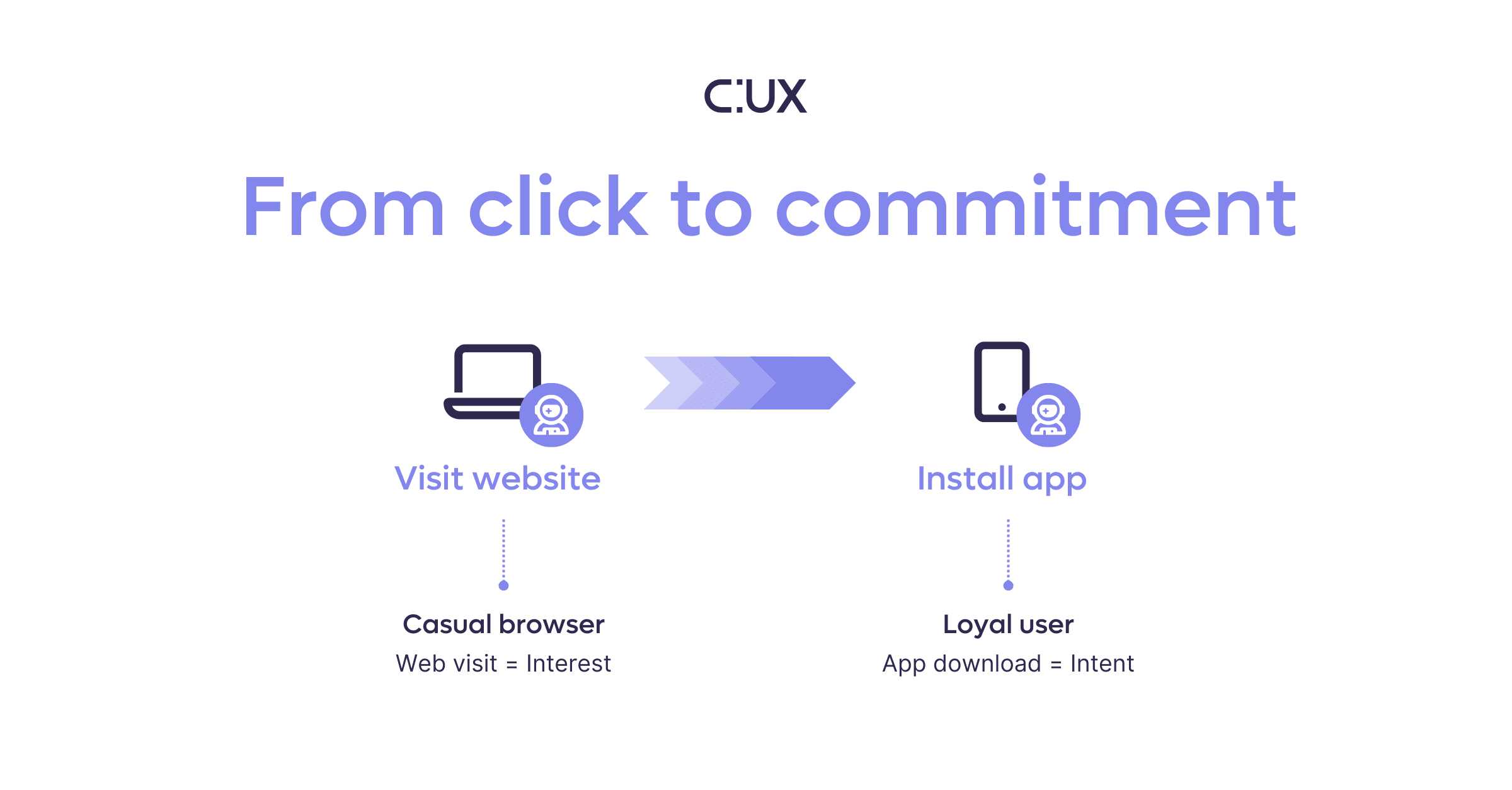
When a customer downloads your app, it’s more than just an install metric. It’s a user raising their hand and saying, "I want a deeper relationship with your brand." They’ve crossed a threshold from casual browser to committed regular.
But are we really listening to that signal? Or are we losing it in the static of a fragmented customer journey?
The challenge is that the customer path is split across platforms. It's a fundamental problem of not seeing the complete picture, which is why CUX digital experience analytics platform is designed to enable true cross-channel analysis and connect what happens in each environment into one, coherent view.
What is cross-channel analysis in CUX?
Cross-channel analysis looks at how the same user or user groups behave across different environments, for example, on your website versus in your mobile app, or in mobile web versus desktop web. It compares actions across those contexts to reveal how behavior changes depending on where the customer interacts with you.
This helps define each channel’s role: the app as a loyalty space, the website as a discovery point, and mobile web as the in-between touchpoint.
That’s also why so many brands invest heavily in their mobile apps. An app visit carries stronger intent than a web visit - it’s tied to a logged-in user, clearer identity, and recurring habits. What people do inside the app reflects relationship and trust more directly than what you see across devices on the web.
Cross-device analysis, on the other hand, follows the same user across multiple devices within one channel. for instance, how someone uses your website on a laptop, then returns on their phone or tablet.
At CUX, we focus on cross-channel behavioral analysis - comparing how users interact across environments like web and app to uncover friction, loyalty signals, and conversion barriers hidden in those transitions.
From comparison to connection
You need Cross-Channel Comparison to build your strategy It answers the "what" and "where."
- It allows you to confirm the role of each channel.
- It helps you reach conclusions: "Our website is great for acquisition," or, "Our app is clearly a loyalty tool - our app users buy 3x more and engage 10x more with coupons."
This is great. You’ve now identified your most valuable group: the loyal app user.
But it still leaves a gap - it doesn’t show how users move between those places or what happens in between. That’s the real advantage of CUX. You see the exact moment the experience breaks - when the familiar layout disappears, when navigation shifts, or when an action that worked in the app fails on the web.
This connection turns data into a story. You not only compare isolated environments, but start understanding what your users actually experience across them.
The black hole in your cross-channel journeys
Now that we know we must follow users between environements, we can identify the biggest problem that stops us: the analytical and experiential friction between your app and web platforms.
The journey for a loyal customer is almost never 100% in one place. They get an email newsletter and click a link, which opens your website. They start a purchase on their laptop (web) and want to finish it on their phone (app). This creates two distinct, massive problems:
The analytical problem (Guaranteed): Your data is fragmented. The user's activity on the web isn't connected to their activity in the app. To your analytics, this loyal customer looks like a "new user" with a high bounce rate, making it impossible to see their true, full path. You are analytically blind.
The user problem (Potential): Because the platforms are different, this causes friction. If your website's design is inconsistent with your native app, the user gets confused. The layouts, navigation, and checkout process they learned in the app are suddenly different, forcing them to re-learn everything.
A perfect example of this is the Web View. This occurs when a user taps a button (like "Checkout") in your app, only to be pushed into a mini-browser that opens within the app itself.
Analytically, it's the same black hole: the app tracking stops, a new web-based one starts, and the path is broken. But for the user, it could be even more jarring if the inconsistent layout and navigation (Problem #2) are now happening in a place where they expected the familiar, native experience to continue.
This is the exact moment the promise of a "better than web" relationship is broken, and it's where your quantitative data shows a "drop-off" without ever telling you why.
How to actually listen: Finding the "Why" with CUX
"Listening" to users means moving beyond what is happening (a 40% drop-off) to why it's happening. This is where qualitative analytics becomes essential. CUX behavior analytics platform gives you the tools to see the customer journey through their eyes, specifically designed to solve this cross-channel fragmentation.
Look at the case of a leading retail company - LPP. They faced this exact fragmentation challenge. They began by using CUX in a successful pilot to map their online (web) purchase journey.
Satisfied with the web insights, they expanded their analysis to the mobile app, their strategic loyalty tool. Here, the fragmentation problem was even more complex: a hybrid-code app with 186 unique views. With traditional analytics, reconstructing a user's full path from web to app, and even within the app, was nearly impossible.
By using CUX across both platforms, they were able to find their "why."
On mobile, two clear patterns stood out:
- Almost 50% of all visits started with loyalty actions - users opening the app to check coupons or redeem points before anything else.
- One in three buyers came back to the confirmation screen right after purchase, just to double-check their order.
Those moments told the team more about user trust and habit than any funnel metric ever could.
These are the kinds of game-changing insights that traditional analytics will never show you. Our client found them by applying the same qualitative tools to analyze both their web and app experiences:
Visit Recordings: Watch the user's struggle. Recordings allow you to see the actual cross-channel friction. You can watch a loyal app user hesitate on your main website, their thumb pausing, looking for the app's navigation bar that isn't there. You've found the why.
Heatmaps: This is your visual proof of the layout's "mismatch." For example, your native app "Cart" screen might have a large, green "Next" button at the bottom.
However, your website "Checkout" page might have a small, blue "Continue" link at the top. A heatmap of that website page will instantly reveal the user's confusion. You'll see a bright red cluster of "dead clicks" at the bottom of the screen, right where users expected the "Next" button to be based on their habit from the native app.
From blind spots to loyalty gains
Your most loyal customers are sending you a clear signal. The app download is the beginning of that conversation. But that signal gets lost in the fragmented journey between your web and app platforms, creating an analytical blind spot and a point of high user friction.
To truly listen, you must:
- Compare behavior across app and web to reveal the full behavioral path (true Cross-Channel Analysis).
- Experientially observe that path with qualitative tools like visit recordings and heatmaps to find and eliminate the moments of confusion.
This is how you truly serve your most loyal customers: by seeing the journey through their eyes. CUX's cross-channel qualitative analytics are built to give you that exact perspective.
The signal is there. CUX helps you hear it.